
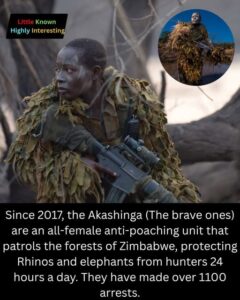
 Deep in the wilderness of Zimbabwe’s Lower Zambezi Valley, a group of women are doing what was once considered unthinkable — going toe to toe with some of the most dangerous and heavily armed criminals on the continent.
They are the Akashinga, meaning “The Brave Ones” in the local Shona language, and since their founding in 2017, they have been quietly rewriting the rules of wildlife conservation.
The unit was created by Damien Mander, a former Australian special forces soldier, under the International Anti-Poaching Foundation. Rather than recruiting from traditional military circles, Mander specifically sought out Zimbabwe’s most vulnerable women — survivors of domestic abuse and sexual assault, single mothers, orphans, and abandoned wives.
He reasoned that women who had already survived the worst had both the resilience and the community ties needed to make the programme work.
Training is modelled on special operations forces preparation — a gruelling process — and only a fraction of applicants make it through.
What followed has been remarkable. Patrolling over nine million acres across Zimbabwe and beyond, the Akashinga protect elephants, rhinos, and lions from poachers who use guns, snares, and cyanide traps.
Since 2017, they have made over 1,100 arrests — achieving an 84 percent conviction rate — without firing a single shot. Their community-based approach has contributed to an 80 percent reduction in elephant poaching in the Lower Zambezi Valley alone.
Beyond the bush, the programme supports over 2,000 indigenous Zimbabweans, funds schools, and pumps money directly back into local households. National Geographic documented their story in a short film produced by James Cameron.
Leave a Reply
You must be logged in to post a comment.