
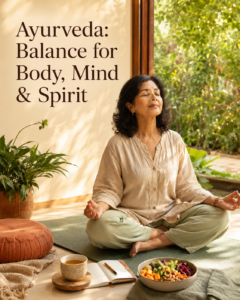
 Have you ever wondered what it would be like to approach your health as something you actively create rather than something you only think about when a problem arises?
That idea is at the heart of an Ayurvedic lifestyle.
Ayurveda is a traditional system of health and well-being that originated in India more than 5,000 years ago. Rather than focusing only on treating illness, Ayurveda encourages us to maintain balance by paying attention to the factors that influence every part of our lives—physical, mental, emotional and spiritual.
The underlying goal of Ayurveda is satisfaction. We might also describe it as fulfillment, contentment, balance or success. Whatever word we choose, most of us are ultimately seeking the same thing: to feel well, live meaningfully and experience greater satisfaction in our daily lives.
Health Is the Foundation
We all have responsibilities, goals and activities that seem important. It is easy to fit our health around everything else—taking care of ourselves only after the work is finished, the family is cared for and the to-do list is complete.
Ayurveda invites us to reconsider that order.
Our health affects every other area of our lives. No matter what we accomplish, it can be difficult to enjoy it when we do not feel well. Caring for our physical health is not a distraction from the things that matter. It provides the foundation that allows us to participate in them more fully.
Ayurveda offers practical guidelines for supporting our well-being. What we do with those guidelines remains our choice. The purpose is not to follow a rigid set of rules or to be perfect. It is to expand our awareness so that we can recognize our choices and understand that those choices may have consequences.
Becoming an Active Partner in Your Health
Many of us grew up taking our health for granted. We may have believed that if something went wrong, we would simply visit a doctor and be “fixed.”
Doctors and other healthcare professionals play an essential role in our lives, but we are also becoming more aware that health requires our participation. Our bodies possess an extraordinary natural intelligence. An entire world of activity is taking place within us every moment—breathing, digesting, healing, adapting and responding.
Our mind and body are the partners we have been given for traveling through this human experience. Taking care of them is both a responsibility and an act of self-respect.
This does not mean blaming ourselves when illness occurs, nor does it mean replacing appropriate medical care. It means recognizing that our everyday choices—how we eat, rest, move, breathe and respond to stress—can influence how we feel.
Creating a Plan for What Matters
An Ayurvedic lifestyle begins with awareness and intention.
It is in our best interest to have a plan for focusing on what matters to us. We may not follow that plan perfectly every day, but having one helps us notice when we are making a different choice. Instead of moving through life on autopilot, we become more conscious participants in our own well-being.
Ayurveda includes guidance for many areas of life. Practices that support mental, emotional and spiritual awareness may include:
- Meditation
- Conscious breathing exercises
- Gentle stretching and movement
- Focus and mindfulness techniques
- Nourishing daily routines
- Adequate rest
- Greater awareness of the body’s signals
These practices help us slow down, listen and develop a deeper relationship with ourselves.
Why Consider an Ayurvedic Lifestyle?
You might choose to explore Ayurveda because you want to feel more balanced, become more intentional about your health or create habits that support your next chapter. You may be tired of reacting to problems and ready to take a more proactive role in your well-being.
Adopting an Ayurvedic lifestyle does not require changing everything at once. It begins by learning the principles, paying attention to your own mind and body, and making thoughtful choices based on what you discover.
Physical health gives us a strong foundation, but Ayurveda also invites us to explore a much bigger question: Who are we beyond our roles, responsibilities and physical bodies?
For those of us who are rediscovering who we are and deciding how we want to live the next chapter of our lives, that question can open the door to remarkable possibilities.
Perhaps the first step is simply to pause and ask yourself:
What would change if caring for my health became one of my highest priorities?