
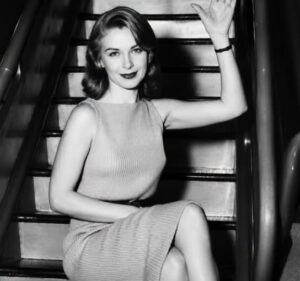
 She wore a $100 dress she sewed herself to accept the Oscar — and Hollywood never let her forget it.
On March 26, 1958, a 28-year-old actress from a small town in Georgia walked onto the biggest stage in show business to accept the Academy Award for Best Actress.
She wasn’t in a designer gown. She was wearing an emerald green dress she had cut, sewn, and finished herself, over two weeks, for about $100 in fabric.
Hollywood’s old guard was not amused.
Joan Crawford — one of the most powerful women in the industry — reportedly sniffed that by making her own clothes, this newcomer was “setting the cause of Hollywood glamour back 20 years.”
The newcomer’s name was Joanne Woodward. And she never apologized for a single stitch.
Years later, a museum in her home state asked to display the dress. She said no. She’d made it with her own hands, she explained — and she was almost as proud of it as she was of the Oscar itself.
That kind of quiet defiance would define the rest of her life.
Woodward could have chased the manufactured glamour Hollywood wanted from its leading ladies. Instead, for the next four decades, she chose the opposite: frustrated housewives, lonely teachers, women in crisis — roles that were honest instead of flattering. She and her husband, Paul Newman, raised their three daughters in Connecticut, far from the spotlight, and stayed married for 50 years in an industry that rarely rewards that kind of staying power.
Then, in 1985, she played a university professor slowly losing her mind to Alzheimer’s disease in the TV movie Do You Remember Love. It won her an Emmy. Critics called it one of the finest performances of her career.
Twenty-two years later, Joanne Woodward was diagnosed with Alzheimer’s herself.
A year after that, Paul Newman died.
In 2022, their daughter asked director Ethan Hawke to make a documentary about her parents’ lives — while Joanne was still alive to see it, to feel the love it was made with.
She’s 96 now. One of the last living stars from an entire vanished era of Hollywood — the studio contracts, the searchlights, the anthology television — a world that now survives mostly in old film reels.
She played a woman with three different personalities and made every one of them real. She played a woman losing her memory, decades before the same disease found her.
And on the biggest night of her career, she stood in front of all of Hollywood in a dress no one else had touched but her.
She never gave that dress away. She never needed anyone’s approval to be proud of it.
Leave a Reply
You must be logged in to post a comment.