
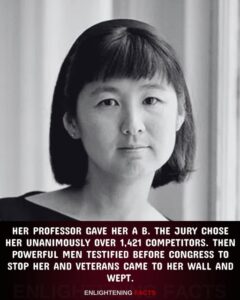
 May 1981. Yale University.
Maya Lin was studying for finals when someone knocked on her dorm room door.
Two men stood in the hallway asking if she was the Maya Lin who had submitted entry number 1026 to the Vietnam Veterans Memorial competition.
Her stomach dropped. Had she broken some rule?
“You won,” they said.
Out of 1,421 anonymous entries — submissions from decorated architects, established design firms, professionals who had spent careers building monuments — the jury had chosen hers.
Maya was twenty-one years old. A senior architecture student. She had never designed anything that actually got built.
She had just won the most significant memorial competition in modern American history.
For approximately forty-eight hours, she felt pure joy.
Then America learned who she was.
Rewind to fall 1980.
Maya’s architecture professor at Yale was teaching a seminar on funerary design. When he mentioned a national competition for a Vietnam War memorial in Washington D.C., it seemed like a good portfolio piece. The competition was open to anyone — no age limits, no credentials required, entries judged anonymously.
Maya had spent time studying how different cultures approached death and remembrance. She’d noticed that some cultures integrated cemeteries into daily life rather than hiding them away. Death wasn’t morbid — it was honest.
For this memorial, she wanted something that didn’t glorify war or make political statements. Something that honored 58,000 individual human beings who had died — not abstract concepts like heroism or sacrifice.
She sketched two polished black granite walls forming a wide V, cutting into a gentle slope. The surface would reflect visitors while displaying every single name, listed chronologically by when they fell. Walking toward the center, you’d descend below ground level, surrounded by the accumulating weight of names. Then you’d ascend back to the present.
Simple. Quiet. Brutally honest.
Her professor gave her a B.
Maya submitted it anyway.
Established architects submitted elaborate designs — traditional white monuments reaching skyward, heroic bronze soldiers, flags, eagles, classic patriotic imagery.
The jury examined every entry without knowing who created them. No names. No résumés. Just designs.
They chose Maya’s unanimously.
The jury praised its extraordinary power and appropriateness — its honesty, its refusal to romanticize war, its focus on individual loss rather than political messaging.
Then they opened the envelope.
A college student. Still finishing her senior year.
When Maya’s identity became public, the backlash was immediate and vicious.
A degrading ditch. A black scar of shame. An insult to veterans.
Prominent veterans groups erupted. They had expected something traditional — white marble reaching toward heaven, heroic soldiers cast in bronze, symbols of honor and glory.
Not this dark thing designed by a twenty-one-year-old girl who hadn’t even been alive when the war started.
Then they learned she was Asian-American, and the attacks turned uglier. How dare an Asian woman design a memorial for Americans who died fighting in Asia — never mind that Maya was born in Ohio, as American as anyone criticizing her.
She was young. Female. Asian. That was enough.
Decorated military officers testified before Congress demanding the design be scrapped. Major donors threatened to withdraw millions. The Secretary of the Interior refused to issue construction permits. Maya received death threats. Hate mail piled up.
She was barely out of college, sitting in congressional hearings while powerful men who had never met her questioned her patriotism, her qualifications, her right to participate in American civic life.
She attended meeting after hostile meeting, calmly defending her vision to audiences determined to destroy it.
She explained repeatedly: the black granite would reflect visitors’ faces, connecting the living with the dead. The chronological listing placed each name alongside the soldiers who died the same day — recreating the bonds formed in combat. Descending below ground wasn’t degrading. It was intimate. A space for personal grief rather than public propaganda.
The simplicity wasn’t disrespectful. It was honest. Fifty-eight thousand names speaking for themselves without politicians or generals telling people how to feel.
After months of brutal fighting, officials proposed a compromise: build Maya’s wall as designed, but add a traditional statue and flagpole nearby to appease critics.
Maya reluctantly agreed. The wall itself was what mattered.
Construction began in 1982.
November 13, 1982. The Vietnam Veterans Memorial opened to the public.
Veterans approached cautiously. Many had opposed the design. Some arrived expecting to feel insulted.
Then they saw the names.
They touched the polished black granite. Traced letters of friends who had died fifteen years earlier. Found names they had been searching for since the war ended.
They wept.
They left flowers at specific panels. Made pencil rubbings to take home. Brought their children to show them which names mattered.
Within days, veterans who had testified against the memorial returned and stood in silence before it. The monument they had called a black scar had become sacred ground.
Critics who had demanded Maya’s design be destroyed brought their families to visit. The items people left at the wall — letters, photographs, combat boots, wedding rings, children’s drawings — revealed what Maya had understood from the beginning: this wasn’t about politics or glory. It was about 58,000 individual human beings. And the people who loved them needed a place to grieve honestly, without being told how to feel.
The National Park Service now collects and preserves every item left at the wall. More than 100,000 objects annually. All catalogued. All saved.
Today, more than five million people visit the Vietnam Veterans Memorial each year.
More than the Lincoln Memorial. More than the Washington Monument. More than any other monument in Washington D.C.
The design that nearly didn’t get built became the most visited memorial in America.
Before Maya Lin, monuments were about glory — heroic figures, patriotic symbols, messages about honor and sacrifice. After her wall, memorials could be about truth. About individual human cost. About grief acknowledged rather than propaganda enforced.
She was told she was too young to understand. Too female to design something serious. Too Asian to honor American dead.
Powerful men testified before Congress that her vision was fundamentally wrong.
She built it anyway.
And when veterans finally stood before those polished black walls and saw their own reflections merging with the names of the dead — they understood what she had known all along.
Honesty honors the dead more than propaganda ever could.
Her professor gave her a B.
The jury chose her unanimously over 1,421 competitors.
Congress tried to stop her.
Veterans initially hated it.
Now it is the most visited monument in Washington D.C. — and Maya Lin, the twenty-one-year-old student they said didn’t understand sacrifice, created the most powerful war memorial in American history.
Not by glorifying war.
By telling the truth about what it costs.
Fifty-eight thousand names. Every one of them someone’s son, brother, father, friend.
Her professor gave her a B. The jury chose her unanimously. Congress tried to stop her. Veterans wept at the wall. That is the complete story.
Compliments of Enlightening Facts
Elaine Koyama A long time friend of mine
I have been there and it is everything this essay says. And I remember the debate that a woman of Asian descent could or should be the designer. I thought at the time and still do feel it most appropriate since we killed thousands and thousands of nameless Asians in that war.
“All we are saying, is give peace a chance.”
Leave a Reply
You must be logged in to post a comment.