
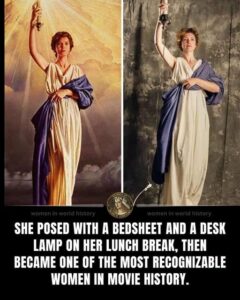
 She went out on her lunch break, wrapped herself in a bedsheet, held up an ordinary desk lamp, and accidentally became one of the most recognizable women in movie history.
In July 1991, Jenny Joseph was a 28-year-old graphic artist working at The Times-Picayune in New Orleans. She wasn’t an actress. She wasn’t a professional model. In fact, she had never modeled before. Artist Michael Deas had been commissioned to create a new version of Columbia Pictures’ famous torch-bearing woman, and when he saw Joseph, he knew he had found his reference.
Photographer Kathy Anderson turned the living room of her New Orleans apartment into a makeshift studio. Joseph arrived during her lunch break. There was no magnificent costume or flaming torch. She was wrapped in a white sheet with blue fabric draped across her body, placed on boxes, and handed a small lamp with the shade removed.
Then came a detail that makes the photographs even more remarkable.
During the shoot, Joseph asked if she could sit down. She quietly revealed that she was pregnant. Anderson became concerned about having her standing on the box, but the session continued.
Deas took those photographs and painted Joseph into something monumental. The apartment disappeared. The lamp became a blazing torch. Clouds filled the background. Light exploded across the sky.
And
The finished image debuted in the early 1990s and became the studio’s enduring modern Torch Lady. Joseph never pursued modeling afterward.
Millions of people would see her before movies without ever knowing her name.
One of Hollywood’s grandest images began with a pregnant newspaper employee, a bedsheet, a desk lamp, and a lunch break.
Leave a Reply
You must be logged in to post a comment.