
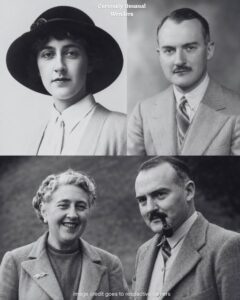
 She was forty years old, divorced, and already famous. He was twenty-six, a young archaeologist digging in the Iraqi desert. When he asked her to marry him, she said no. They argued for two whole hours in the rain before she finally changed her mind and decided to take a leap of faith.
This decision did not just change her personal life; it challenged how the entire world viewed age and love in the 1930s.
Four years earlier, Agatha Christie’s life had seemingly fallen apart. Her first husband had demanded a divorce, sparking a massive public scandal.
Devastated, she famously disappeared for eleven days, eventually turning up at a hotel under a fake name, claiming she had amnesia. The newspapers turned her real-life pain into a mystery for the public to solve.
Seeking peace, sunshine, and a way to escape her past, she decided to travel alone to Baghdad in March 1930.
It was among the ancient ruins of Ur, in modern-day Iraq, that she met Max Mallowan.
He was working as an assistant at the excavation site and was tasked with showing Agatha around. Max was young, warm, and deeply passionate about his work. He showed her ancient pottery and thousands-of-years-old ruins with so much enthusiasm that the ancient world came alive for her.
The fourteen-year age gap between them quickly became a meaningless detail.
When the digging season ended, Max visited Agatha at her home in Devon, England. On their second evening together, while walking under the English rain, he asked her to marry him.
Agatha immediately said no.
For two hours, they stood there and debated. Agatha was terrified of the age difference. In the 1930s, a forty-year-old divorced mother was considered an older woman, while Max was a twenty-six-year-old at the very beginning of his career.
“It will not work,” Agatha insisted during their debate. “People will talk. I will care too much about you. I am simply too old.”
But Max refused to back down. He did not care about societal expectations or gossip. He looked at her and said,
“I do not care about the age difference or what people say. I see your brilliance, and that is all that matters.”
Agatha
decided to choose happiness over fear. The couple married in September 1930, ignoring the whispers of a judgmental society that claimed the marriage would never last.
They proved everyone wrong for forty-six years.
Their relationship became a beautiful, lifelong partnership. Every autumn and spring, Agatha joined Max on his archaeological digs in the Middle East.
She became the official photographer for his digs, mixing chemicals to develop photos in improvised darkrooms. She even cleaned ancient ivory relics using her own expensive face cream.
“There is almost none left for my poor old face!” she joked to Max.
Max deeply appreciated her help, later writing, “Agatha’s controlled imagination was a massive help in preserving the most delicate artifacts.”
During World War II, when they were separated by the war effort, they wrote to each other every single day. Agatha wrote to him saying she missed him with a “corkscrew-like feeling,” and Max replied that he felt a constant “emptiness, like hunger.” They were intellectual equals, creative partners, and best friends.
Agatha once described their marriage beautifully: “We are like two parallel railway tracks—each needs the other close, without ever merging.”
While traveling with Max, Agatha wrote some of her most famous novels, including Murder on the Orient Express and Death on the Nile. Both of them achieved great heights; Max was eventually knighted for his contributions to archaeology, and Agatha was made a Dame.
When Agatha died in 1976 at the age of eighty-five, she left behind an incredible legacy of literature.
Max passed away two years later, and today they rest side-by-side in a quiet churchyard in Oxfordshire, their initials intertwined on a single headstone.
It is a heartwarming reminder that true love does not look at a birth certificate; it looks at the soul.
Yet, their story leaves us with a challenging question for our modern world. Today, we have endless dating apps and advanced technology, but we often swipe left and discard potential love at the slightest inconvenience, age difference, or fear of judgment.
If a divorced middle-aged woman in the conservative 1930s had the courage to ignore society and say yes to a younger man, why are we still letting fear and superficial standards keep us lonely today?
Leave a Reply
You must be logged in to post a comment.