
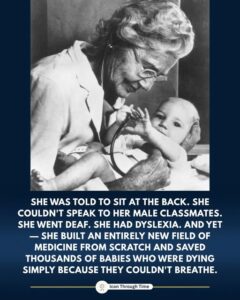
 They told her she didn’t belong.
In the early 1900s, a young woman named Helen Taussig walked into a world of medicine that had been built entirely without her in mind. She had severe dyslexia — reading was a daily battle. A childhood ear infection had begun stealing her hearing, a loss that would eventually become complete deafness. And yet, those were the least of her obstacles.
When she applied to Harvard’s School of Public Health, she was turned away — not because of her grades, not because of her intelligence, but simply because she was a woman. So she went elsewhere. When she finally reached medical school, she was forced to sit apart from her male classmates, forbidden to even speak with them during lectures — present in the room, but treated as invisible.
She refused to disappear.
Unable to use a stethoscope as her hearing faded, Taussig did something extraordinary — she learned to feel heartbeats with her fingertips, developing a sensitivity so precise she could detect life-threatening defects that others missed entirely. Through her bare hands, she began to understand what was killing the “blue babies” — infants born with a heart defect so severe their skin turned blue from lack of oxygen. Every doctor before her had called it untreatable.
She called it a challenge.
In 1944, working alongside surgeon Alfred Blalock and the brilliant surgical technician Vivien Thomas, Taussig’s concept became reality. A groundbreaking operation — the Blalock-Thomas-Taussig shunt — gave these children their first real breath. The first patient, a baby girl, survived. Then another. Then thousands more.
The woman who had been told to sit at the back went on to found the entire field of pediatric cardiology — a field that today saves millions of children’s lives around the world.
She didn’t just break barriers.
She built something magnificent on the other side of them.
#WomenWhoChanged History #PediatricCardiology
Leave a Reply
You must be logged in to post a comment.