
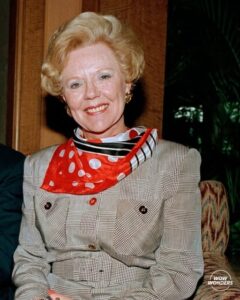
 She died and left a $1.8 billion surprise behind her, and the people who received it didn’t even see it coming.
Not a foundation announcement. Not a press tour. A will.
The woman was Joan Kroc, widow of McDonald’s founder Ray Kroc, and by the time she died in October 2003 she had inherited a fortune built on billions of hamburgers sold to people who never met her. She could have kept every dollar of it locked in a family trust, quietly compounding, the way most fortunes that size are handled.
Instead she gave away roughly half of everything she had, in a single gift, to an organization she had no obligation to.
The Salvation Army received $1.5 billion from her estate, the largest single gift to a charity in American history at the time. Some estimates, once related bequests were counted, put the full figure at $1.8 billion.
There was exactly one condition attached.
The money had to build and run community centers, gyms, pools, theaters, classrooms, in poor and underserved neighborhoods across the country, places where kids had nowhere decent to go after school and nothing built for them at all.
Think about the scale of that for a second.
Kroc’s gift was so large that the Salvation Army, an organization that had operated for over a century on modest donations and thrift store revenue, had to entirely rethink how it planned budgets just to absorb it responsibly. Twenty-six Kroc Centers were eventually built across the country, in cities that had never had anything like them.
She had done something almost identical before, and it barely made headlines compared to what came next.
In 2003, the same year she died, Kroc bequeathed more than $200 million to National Public Radio, the largest gift any American cultural institution had ever received. It was, at the time, more money than NPR’s entire annual budget many times over, arriving from a woman who by her own account wasn’t even a devoted listener. Public television’s flagship network, PBS, reportedly never returned her phone call. NPR did. NPR got the gift.
That’s the whole story of how $200 million gets decided sometimes. A phone call answered.
Kroc gave to causes that had nothing to do with fast food, nothing to do with her late husband’s business, and often nothing to do with anything that would put her name on a building people would recognize. She funded anti-hunger programs, peace initiatives, addiction treatment centers, AIDS research, all quietly, all disproportionate to any tax benefit or personal recognition she stood to gain.
She had no legal obligation to give any of it away. As Ray Kroc’s widow, she could have kept the fortune entirely inside her own family, the way most estates that size are structured to do.
If you’ve ever swum in a public pool at a Kroc Center, taken your kid to a free after-school program in one, or listened to an NPR station that survived a budget crunch because of an endowment built on her gift, you have touched something she built without ever being asked to.
She was sometimes called a difficult woman to predict, generous in ways that surprised even the people closest to her, uninterested in credit for most of it.
The Salvation Army had never received anything close to $1.5 billion before. It hasn’t received anything close to it since.
A woman who could have kept it all quietly instead spent her final act giving away half of everything, and asked for nothing back except that poor kids somewhere get a gym.
Compliments of WOW Women
Leave a Reply
You must be logged in to post a comment.