
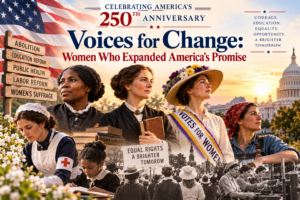
 As America celebrates 250 years, we honor not only those who built the nation, but also the women who continually challenged it to live more fully into its promise of freedom and opportunity.
Throughout American history, women have looked at injustice, inequality, poor working conditions, limited education, and inadequate healthcare and asked a powerful question: “How can we make this better?” Many had little formal authority, yet they discovered that their voices, determination, and willingness to work together could create extraordinary change.
During the abolition movement, women such as Harriet Tubman risked their lives helping enslaved people reach freedom, while Sojourner Truth spoke publicly for abolition and women’s rights. Their courage demonstrated the power of speaking out even when doing so came at tremendous personal risk.
Education became another pathway to change. Mary McLeod Bethune, born to formerly enslaved parents, became an educator and founded a school that eventually became Bethune-Cookman University. She understood that education could transform not only an individual life but generations of families.
Women also became powerful advocates for public health and safer communities. Clara Barton cared for wounded soldiers during the Civil War and later founded the American Red Cross. Lillian Wald helped pioneer public-health nursing, bringing healthcare into underserved neighborhoods.
As America industrialized, women fought for safer workplaces, fair wages, and reasonable working hours. Reformers such as Frances Perkins advocated for protections that eventually benefited millions of American workers.
And for generations, women organized, marched, wrote, spoke, and peacefully demanded the right to vote. Leaders including Susan B. Anthony, Elizabeth Cady Stanton, Ida B. Wells, and Alice Paul helped carry a movement that culminated in the 19th Amendment in 1920, although many women of color continued to face barriers to voting afterward.
Rediscovering Themselves
Perhaps there is another lesson hidden within these stories.
As these women worked to change America, they also rediscovered themselves. A teacher discovered she could become a leader. A nurse became an organizer. A woman who had been told to remain silent discovered the power of her voice.
They remind us that rediscovery doesn’t always begin by asking, “Who do I want to become?” Sometimes it begins when we see something that needs changing and decide, “I can do something about that.”
Two hundred and fifty years later, that invitation belongs to us.
Reflection: What do you care deeply enough about to lend your voice, experience, or talents to creating positive change?
Leave a Reply
You must be logged in to post a comment.