
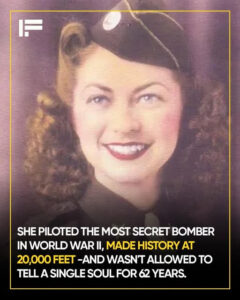
 On May 4, 1944, twenty thousand feet above Kansas, a 25-year-old woman crawled through a narrow, pressurized tunnel directly over an open bomb bay and slid into the pilot’s seat of the most powerful bomber ever built.
Her name was Mildred “Micky” Axton.
She became the first woman in history to fly the B-29 Superfortress — the plane that would later drop atomic bombs to end World War II.
And almost no one knew it happened.
The B-29 was not just an aircraft. It was the most classified piece of military technology in existence. A 141-foot, 30-ton giant so advanced that factory workers were forbidden to discuss what they were building. To even be aboard required top-level security clearance.
Micky wasn’t supposed to be there.
She had joined the Women Airforce Service Pilots — the WASPs — in 1943. These women ferried bombers across the country, towed live-fire targets for combat training, and tested aircraft fresh from the factory that male pilots sometimes refused to touch.
It wasn’t combat. But it wasn’t safe.
Micky trained for six brutal months, graduated, and was assigned as a test pilot. She signed off on B-25s, B-26s, and eventually B-29s before they were cleared for war. When one male pilot told her he’d rather die in combat with glory than in Texas testing a broken plane, she understood exactly what he meant.
She flew the broken planes anyway.
Six weeks after transitioning to Boeing in Wichita as a flight test engineer, she was on board “Sweet Sixteen” — the 16th B-29 ever manufactured — monitoring engines during a routine test flight.
Then the chief engineer’s voice came over the intercom.
“Micky — how’d you like to come fly this thing?”
She had seconds to decide.
She strapped on her parachute and crawled through the dark tunnel over the open bomb bay.
She emerged breathing hard, slid into the left seat — the pilot’s seat — and took the controls.
For the next twenty minutes, Micky Axton flew the B-29 Superfortress. Banking. Adjusting throttle. Feeling thirty tons of the most powerful bomber ever built respond to her hands.
When the flight ended, she wanted to shout it from every rooftop in Kansas.
Instead, she went home and whispered it quietly to her husband.
Because it was classified. All of it. Every second of it.
The chief engineer wrote her a letter confirming what she had done, sealed it away, and the secret went with it.
What happened to the WASPs next is one of American history’s quieter shames.
1,074 women flew for the program. They logged 60 million miles across 78 types of aircraft. Thirty-eight of them died in service. When a WASP was killed, there was no military funeral, no benefits, no flag for the family. Her fellow pilots passed a hat to cover the cost of sending her body home.
In December 1944 — despite everything they had proven — the program was disbanded. The women went home without veteran status, without the GI Bill, without recognition of any kind.
For 33 years, the United States government officially acted as though they had never existed.
Micky went back to teaching. Biology, science, and aeronautics at East High School in Wichita. She spoke at schools. She flew in air shows. She kept the story alive the only way she was permitted to — quietly, one student at a time.
In 1977, President Carter finally signed legislation granting WASPs veteran status. Micky was 60 years old.
In 2006 — 62 years after the flight — Boeing published her story. The sealed letter finally came to light. The world learned that a 25-year-old woman from Kansas had been the first to pilot the plane that ended World War II.
In 2009, the Commemorative Air Force restored a vintage PT-19 trainer and named it Miss Micky. When they asked her what she wanted on the nose art, she laughed: “OK — but give me a decent swimsuit.”
Miss Micky flies today with a red swimsuit painted on her nose.
That July, President Obama signed legislation awarding the WASPs the Congressional Gold Medal — the highest civilian honor Congress can give.
Micky Axton died on February 6, 2010. She was 91.
The medal ceremony was March 10, 2010.
Her family accepted it for her.
She never dropped a bomb in her life.
But on May 4, 1944, twenty thousand feet above Kansas farmland, she shattered something heavier than any bomb could touch — the assumption that the sky had a ceiling for women.
She crawled through a dark tunnel over an open bomb bay because someone believed she belonged in that cockpit.
Then she spent the next six decades making sure the children she taught believed the same thing about themselves.
The Congressional Gold Medal arrived 66 years too late.
But the door she opened?
That one’s been flying ever since.
Leave a Reply
You must be logged in to post a comment.