
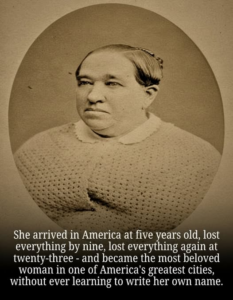
 The ship arrived in 1818.
Margaret Gaffney was five years old, the daughter of Irish farmers who had watched two consecutive harvests fail and decided that whatever the New World held, it could not be worse than starving in Leitrim. The crossing took months. By the time land appeared, passengers had been rationed to a single cracker a day.
They settled in Baltimore. Her parents were not wealthy, but they were alive and together, and for a few years that was enough.
Then yellow fever came.
In 1822, it moved through the immigrant quarters of Baltimore without distinguishing between the deserving and the helpless. Margaret’s mother died. Her father followed. She was nine years old. A Welsh woman who had made the crossing with the Gaffney family took the girl in — not out of sentiment, but out of necessity. Margaret worked for her keep. There was no school, no formal kindness, no one explaining what came next. She learned to do what the day required and ask nothing beyond it.
She never learned to read. She never learned to write. She would carry that fact for the rest of her life — not as shame, but as the simple truth of what poverty does to the smallest and youngest first.
By her early twenties, Margaret was working as a laundress in Baltimore, saving every penny with the particular discipline of someone who has already learned, twice, that everything can disappear. In 1835, she married an Irish-born man named Charles Haughery. He was not well — his health had always been fragile — and Margaret persuaded him that a warmer city might help. They boarded a ship south and arrived in New Orleans in November of that year.
She gave birth to a daughter they named Frances.
For the first time since childhood, something in Margaret’s life felt like shelter.
Then it began again.
Charles’s health worsened. Doctors recommended the sea air of his native Ireland. He made the voyage. Months passed. A letter arrived: he had died shortly after reaching home. And then, before Margaret could fully absorb the weight of that, Frances became ill. She was an infant. She did not survive.
Margaret was twenty-three years old. She had lost her parents, her husband, and her child. She was Irish, Catholic, illiterate, and alone in a city that regarded all three of those things as reasons to look away.
She did not break.
She went to work as a laundress at a hotel on Canal Street. She spent her evenings with the Sisters of Charity — Catholic nuns who ran an orphanage on the edge of the city, caring for children no one else would take. Margaret began volunteering there. She saw their faces — hungry, unclaimed, too young to understand why they had been left — and she saw herself in every one of them.
She saved her wages. She bought two cows. She began delivering milk through the French Quarter before sunrise, her cart rattling over the cobblestones in the dark, knocking on doors, building a clientele through sheer constancy and honesty. She gave the Sisters of Charity milk every day and refused payment. She told them she remembered what hunger felt like.
The dairy grew. Two cows became forty. Cream and butter joined the milk. She loaned money to other businesses, quietly and without fanfare. Then a baker she had lent money to went under, and the only way to recover what she was owed was to take over the operation herself.
She had never baked professionally in her life. She could not read a recipe.
She learned by feel, by repetition, by the same refusal to fail that had carried her through everything else. Within months, her bread was selling across the city. She invested in steam-powered machinery — becoming the first bakery in the South to operate by steam — and eventually built what became one of the largest commercial bakeries in the United States. She exported beyond New Orleans. She introduced packaged crackers to the local market. She employed forty men.
Every evening, she distributed the day’s unsold bread to whoever was waiting at the door. And they were always waiting.
When yellow fever returned, Margaret nursed the dying in their homes. She went door to door through the sick quarters, sitting with people who had no one else, promising dying mothers that she would look after their children.
She kept every promise.
When the Civil War came and Union forces occupied New Orleans, General Benjamin Butler imposed martial law — barriers, curfews, and the threat of execution for anyone who crossed the lines. Margaret kept delivering bread to the poor on both sides. When Butler summoned her and warned she would be shot if she continued, she looked at him without blinking and asked whether it was truly President Lincoln’s policy to let the poor of New Orleans starve to death.
Butler stared at her for a long moment.
Then he said: “”””You are not to go through the picket lines without my permission. Is that clear?””””
“”””Quite clear,”””” Margaret answered.
“”””You have my permission,”””” Butler replied.
She fed Union soldiers and Confederate families, the Catholic and the Protestant, the white child and the Black child, without asking which side anyone stood on. She helped establish and sustain nearly a dozen orphanages across the city. She sat at the door of her bakery every day in the same plain calico dress and Quaker bonnet, a smile for everyone who passed, wise counsel for anyone who asked. She never owned more than two dresses in her life.
Margaret Gaffney Haughery died on February 9, 1882.
The mayor of New Orleans led her funeral procession. Two governors of Louisiana served as pallbearers. The city’s newspapers ran their columns in black. When her will was read, it was discovered that despite a lifetime of giving, she had saved a remarkable sum — and she left every cent of it to the orphanages of New Orleans. Whether the children were white or Black, Catholic, Protestant, or Jewish, made no difference, she had always said. They are all orphans alike.
Her will was signed with a cross.
She had never learned to write her name.
In 1884, the city unveiled a marble statue in her honour in a small park in the Lower Garden District. The pedestal beneath it bears a single word.
Not her title. Not her wealth. Not her accomplishments.
Just: Margaret.
Because in New Orleans, nothing more needed to be said.
She arrived on these shores as a frightened child with nothing. She left behind a city of children who were fed, sheltered, and told — by the living fact of her life — that they were not forgotten.
She could not write a single word.
But she rewrote what it means to be human.
Leave a Reply
You must be logged in to post a comment.