
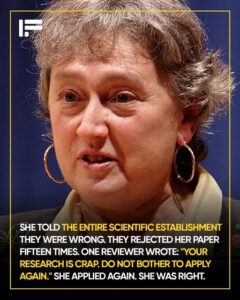
 In March 1938, in Chicago, a girl was born who would spend her life arguing with science—and eventually changing it.
Her name was Lynn Margulis.
She didn’t look like a future scientific revolutionary.
She struggled in school. Called herself a “bad student.” The kind of child teachers punished rather than understood.
But underneath that struggle was something sharper.
She didn’t think the way others did.
And that would become her greatest advantage.
At just 19, she graduated from the University of Chicago and married a young astronomer named Carl Sagan.
He looked outward—toward galaxies.
She looked inward—toward cells.
Their marriage didn’t survive.
While raising children and fighting expectations of what a woman “should be,” Lynn pursued science with relentless focus. She earned advanced degrees from the University of Wisconsin and later University of California Berkeley, building a career while balancing a life that constantly pulled her in opposite directions.
But in the middle of that chaos, she saw something no one else had truly understood.
Inside every complex cell—human, animal, plant—there are tiny structures called mitochondria and chloroplasts.
They generate energy.
They are essential to life.
But they didn’t quite fit.
They had their own DNA.
They divided like bacteria.
They looked like bacteria.
Most scientists ignored this.
Lynn didn’t.
She asked a simple but radical question:
What if they were bacteria?
Not similar.
Not related.
But once-living organisms that had merged with other cells billions of years ago.
This idea—called Endosymbiotic Theory—challenged the foundation of evolutionary biology.
At the time, evolution was understood mostly as competition.
Survival of the fittest.
Random mutations.
Gradual change.
Lynn proposed something different.
That the biggest leap in life’s history didn’t come from conflict—
but from cooperation.
From cells joining together.
From life choosing partnership over isolation.
She wrote a paper explaining it.
And the scientific world responded the way it often does to uncomfortable ideas.
They rejected it.
Again.
And again.
Fifteen times.
One reviewer dismissed her work entirely.
Others didn’t know what to do with it.
It didn’t fit.
It didn’t follow the rules.
It didn’t respect the boundaries of what was already accepted.
Most people would have stopped.
Lynn didn’t.
She kept submitting.
Kept arguing.
Kept pushing.
Until finally, in 1967, her paper was published.
She was 29.
And almost no one paid attention.
For years, her work sat on the edges of science.
Criticized.
Dismissed.
Ignored.
But she kept going.
Because she wasn’t trying to be accepted.
She was trying to be right.
Then, slowly, the evidence began to catch up.
By the late 1970s and early 1980s, advances in genetics revealed something undeniable.
The DNA inside mitochondria and chloroplasts was not like human DNA.
It was bacterial.
Independent.
Ancient.
Exactly what Lynn had said.
Her theory didn’t just survive.
It became foundational.
Today, every biology student learns that complex life exists because ancient cells merged, forming the building blocks of everything we are.
Lynn Margulis didn’t just change a detail.
She changed the story.
She showed that evolution isn’t only about struggle.
It’s also about connection.
About systems forming.
About life building itself not just through competition—
but through collaboration.
Her career brought recognition.
Election to the National Academy of Sciences.
The National Medal of Science from Bill Clinton.
Global respect.
But even then, she never became comfortable.
She kept questioning.
Kept challenging.
Kept refusing to fit neatly into the system she had already changed.
She died in 2011.
But her idea lives inside every cell.
Literally.
Every breath you take.
Every movement you make.
Powered by structures that were once independent life forms.
Ancient bacteria that didn’t compete.
They merged.
Lynn Margulis proved something that goes beyond biology.
That the most powerful breakthroughs often look wrong at first.
That rejection doesn’t mean failure.
And that sometimes, the hardest part of being right—
is waiting for the world to catch up.
Leave a Reply
You must be logged in to post a comment.