
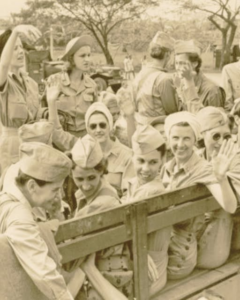
 77 American nurses were taken prisoner. They had already spent months performing surgery in the jungle while bombs fell through the trees above them.**
*Every single one of them survived. The world barely noticed.*
When Japan attacked the Philippines in December 1941, sixty-six Army nurses and eleven Navy nurses were suddenly in the middle of a war zone.
Military rules said women shouldn’t be in combat.
The war didn’t care.
As Japanese forces advanced, the nurses were evacuated to the Bataan Peninsula — where they found no hospital waiting for them. Just dense, humid jungle. They built open-air wards under the trees with whatever they could find, treating thousands of wounded men while Japanese bombers roared overhead and artillery shells tore through the canopy above.
Twenty-hour shifts in suffocating heat. Malaria and dysentery spreading through the wards alongside the wounds of war. When the medicine ran out, they boiled old bandages to sterilize them and rationed the last drops of morphine drop by drop.
*”We stopped thinking about comfort, about fear, about ourselves,”* one nurse later recalled. *”There was always another soldier who needed us more than we needed sleep.”*
When Bataan fell, they retreated to the Malinta Tunnel on the island of Corregidor — working in stifling, dusty darkness, using flashlights to see their patients while the earth shook from constant bombardment.
On May 6, 1942, Corregidor surrendered.
That was the moment they became prisoners of war.
The largest group of American military women ever captured by an enemy.
For nearly three years, they endured the brutal conditions of the Santo Tomas and Los Baños internment camps. Starved on as little as 700 calories a day — moldy rice, watery soup, nothing more. Most lost thirty percent of their body weight, their ribs visible through their skin.
And still, they refused to stop being soldiers.
Under the leadership of Captain Maude Davison and Lieutenant Josie Nesbit, they maintained military discipline in conditions designed to break them. They organized a medical ward from nothing. They fashioned tools from bamboo. They traded their own meager rations for clean water to keep their patients alive.
*”We were so hungry we dreamed about food constantly,”* Lieutenant Juanita Redmond later wrote. *”But we never dreamed about leaving our patients.”*
When American forces liberated the camps in February 1945, the world witnessed something extraordinary: all seventy-seven nurses had survived.
Not one lost.
They came home to a country celebrating victory — and largely expecting them to slip quietly back into traditional roles and say nothing. Their suffering was minimized. Their trauma was ignored. While male soldiers received ticker-tape parades, the Angels of Bataan were treated as footnotes.
Because in the 1940s, society didn’t believe women could experience the horrors of the front lines.
It took decades for history to begin catching up with their courage. The stories came out slowly, in memoirs and interviews and small ceremonies — pieces of a truth the world had been too uncomfortable to hold all at once.
The last surviving Angel, Lourdes “Lulu” Arizala, passed away in 2015.
She left behind a legacy shared by seventy-six women who endured years of captivity, starvation, and suffering — and never once stopped caring for the people in their charge.
They were prisoners. They were starving. They were forgotten.
And they never stopped being nurses.
Some heroes don’t carry weapons. Some hold the line with their bare hands and a boiled bandage and whatever is left of their strength at the end of a twenty-hour shift.
These women held it for years.
They deserve to be remembered by name.
Leave a Reply
You must be logged in to post a comment.