
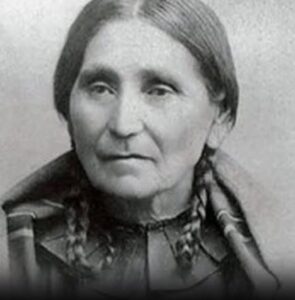
 She was just a child the night she learned what her life would be for.
A woman in her community was dying. She was in terrible pain. A messenger was sent — not once, not twice, but four times — to the government doctor, the man whose entire job was to care for the Omaha people. Four times, he said he was coming. He never came. Before the sun rose, the woman was gone.
When the reason filtered back to the reservation, it was delivered without shame: It was only an Indian. It did not matter.
The little girl who heard those words was named Susan La Flesche. She was the daughter of Iron Eye — Joseph La Flesche — the last recognized chief of the Omaha tribe, a man who had watched the world shift beneath his people’s feet and told his children: Learn. Adapt. Or disappear. Susan took that lesson and turned it into something with a heartbeat.
She left the reservation at fourteen, traveled alone by train across the country to school in New Jersey — a world that had no word for what she was or what she intended to become. She enrolled at one of America’s first medical schools open to women and, in 1889, at the age of twenty-four, graduated first in her class.
She became the first Native American woman to earn a medical degree in the United States.
And then she went home.
Not to a prestigious hospital. Not to a career on the East Coast where colleagues urged her to stay. She went home to a stretch of Nebraska plains covering 450 square miles, where she became the only doctor for more than 1,300 people. She rode on horseback through blizzards, answered calls in the middle of the night, treated everything from complicated births to tuberculosis — and earned a fraction of what white government doctors made for equivalent work.
She taught people to open windows. To cover their coughs. To use separate drinking cups — small instructions that saved lives in ways no official record ever captured.
She petitioned the government for a hospital on the reservation. Every commissioner she reached refused. Native Americans, in the government’s calculation, simply did not merit the same investment.
So she raised the money herself.
In 1913, the Walthill Hospital opened — the first privately funded hospital ever built on a Native American reservation. It had a maternity ward, an operating room, private rooms, and general wards. It admitted everyone, Native and white alike. In its first year, it treated 448 patients.
By the time it opened, Susan was already living with degenerative bone cancer, the disease quietly working through her head, neck, and spine. She kept seeing patients. She kept advocating. She kept showing up.
She died on September 18, 1915. She was fifty years old.
She had been born in a tipi on the Nebraska plains. She had changed the landscape of American medicine. In between, she had ridden through storms to reach families who needed her, sat with people the world had decided didn’t matter, and built — dollar by dollar, year by year — the proof that they did.
The doctor who never came taught her everything.
She spent her entire life being the answer to him.
Compliments of Amazing Stories
Leave a Reply
You must be logged in to post a comment.