
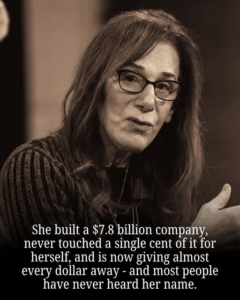
 She is 82 years old. She goes to work every single day. She is worth $7.8 billion. And she has never spent a dollar of it on herself.
Her name is Judy Faulkner. And this is the most quietly remarkable story in American business.
It starts the way the best stories do — not in a boardroom, not with investors lining up to fund a big idea, but in a basement.
The year was 1979. Judy was a young computer scientist in Wisconsin with a mathematics degree, a master’s in computer science, and a vision that most people thought was either impossible or unnecessary. She had $70,000 borrowed from friends and family, two part-time assistants who believed in her, and a single computer roughly the size of a washing machine that she programmed herself, line by painstaking line.
Her idea was simple on the surface but revolutionary in practice: create software that could follow a patient’s medical records across different hospitals and healthcare systems, so that no matter where a sick person ended up, their doctors would know their history.
At the time, medical records lived in filing cabinets. They didn’t travel. They didn’t talk to each other. And when a patient moved, changed hospitals, or showed up in an emergency room far from home, the doctors treating them were often working in the dark.
Judy had seen what that darkness could cost.
Her husband Gordon, a pediatrician, had cared for a young girl for years — knew her history, her conditions, everything about her health. When the family moved to Milwaukee, just 75 miles away, the girl became seriously ill. At the new hospital, the doctors had no access to her records. They didn’t know her history. They did their best with incomplete information. But the pieces came together too late.
The girl died.
It was a tragedy that should never have happened. And it shattered Gordon. But it also galvanized Judy. She went back to her basement and worked harder. This would not happen to another child. Not if she could stop it.
It took nearly two years to build software capable of connecting records across different hospital systems. It took another two years to convince skeptical administrators to actually use it. She faced rejection, doubt, and the quiet dismissal that comes when someone is too far ahead of their time.
But she didn’t stop.
That basement startup is now called Epic Systems.
Today, Epic holds the medical records of more than 325 million people. It operates in roughly half of all hospital beds in the United States — serving institutions like Johns Hopkins, Mayo Clinic, and Cleveland Clinic. The company generates $5.7 billion in annual revenue. And it has never once taken a cent from venture capitalists, never gone public, never been acquired, and never compromised its founding mission for the sake of short-term profit.
Judy is still its CEO. She still shows up every day to work at Epic’s sprawling 1,670-acre campus in Verona, Wisconsin — a place so unusual, with whimsical buildings themed after The Wizard of Oz, Alice in Wonderland, and Harry Potter, that one healthcare executive famously described her as “a female cross between Bill Gates and Willy Wonka.”
She built her empire entirely on her own terms.
“Why be owned by people whose interest is primarily return of equity?” she once said. While her tech-founder peers were ringing bells at stock exchanges and buying superyachts, Judy was writing code and solving problems she actually cared about.
And then came the decision that set her apart from nearly every billionaire alive.
In 2015, she signed the Giving Pledge — the commitment started by Warren Buffett and Bill Gates asking the ultra-wealthy to give away at least half their fortune. But Judy didn’t pledge half. She pledged 99%.
Not most. Not the majority. Nearly everything.
She has never cashed a single share of her Epic stock for personal gain. Not one dollar. Every cent beyond her salary stays in the company or goes to charity. She has been quietly selling her shares back to Epic — roughly $100 million per year — and directing every dollar into the Roots & Wings Foundation, a charitable organization she founded with Gordon in 2019, named after something she once told her own children.
Years ago, her kids told her that what they needed most from her was food and money — security, stability, the practical things. Her answer stopped them cold.
“No,” she said. “What you need are roots and wings.”
Roots to keep you grounded. Wings to help you rise.
Everything else, she told them, is just details.
That idea now powers one of the most active philanthropic foundations in America. Roots & Wings focuses on what every child deserves but not every child receives — the basics of food, shelter, healthcare, and education, alongside real opportunities to grow, to learn, and to become something greater than their circumstances. In 2024 alone, the foundation distributed $67 million to more than 300 nonprofits. The goal is $100 million per year by 2027. The foundation is led by their daughter, Shana Dall’Osto, who brings deep nonprofit expertise to the work her parents began.
And Judy isn’t slowing down. She isn’t retreating to a private island or commissioning a rocket to outer space. She is in Wisconsin. She is at her desk. She is still solving problems, still thinking about the hundreds of millions of patients she will never meet but whose lives her work will touch.
This is what makes her story so extraordinary — not just the scale of what she built, but the reason she built it, and the way she is choosing to leave it behind. In a world where wealth is increasingly measured by how much you can accumulate, how loudly you can announce it, and how many headlines you can generate, Judy Faulkner built something quietly enormous and is now giving almost all of it away.
She never needed the world to know her name. She just needed the work to matter.
She asked her children what they needed most from her. They said food and money.
She told them they needed roots and wings.
And now, at 82, she is spending a $7.8 billion fortune making sure millions of strangers’ children can have both.
Some legacies are written in headlines. Hers is being written in lives.
Leave a Reply
You must be logged in to post a comment.