
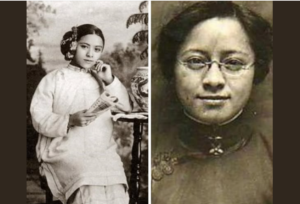
 She was twelve years old — maybe fourteen, history isn’t entirely sure — when her parents made a decision that was meant to seal her fate.
Her older sister had refused an arranged marriage to a much older man in Montana and run away with the man she loved. That left a problem. And in 1899 Chinatown, problems were solved practically. So Tye Leung was offered up instead.
She ran.
With nowhere else to go, she fled to the only door she trusted: the Presbyterian Mission on Sacramento Street, where a fierce and compassionate woman named Donaldina Cameron took her in. Cameron didn’t see a runaway. She saw someone escaping chains — and she opened the door wide.
That single act of refuge would set the course of American history.
Tye Leung didn’t just survive the Mission. She thrived. She learned. She translated in courtrooms as Cameron fought to free Chinese women from sex slavery, giving voice to women who had none. She discovered something profound about herself: she was not someone to be traded or silenced. She was someone who could speak — and speaking, she could change things.
So in 1910, she walked into a federal civil service exam and passed it.
She became the first Chinese American woman ever employed by the United States federal government, assigned to the Angel Island Immigration Station — the place where hundreds of thousands of immigrants were detained, interrogated, and often turned away. In the women’s quarters, she translated their words, witnessed their fear, and made sure their voices reached the people with the power to decide their fate.
She was doing what she had always done: standing in the space between the powerless and the powerful, refusing to let silence win.
Then, on May 19, 1912, she did something else no Chinese woman had ever done in America.
She voted.
California had granted women the right to vote the previous year, and Tye Leung stepped forward to claim that right — studied, prepared, and deliberate. When a reporter asked her about the experience afterward, she didn’t speak of excitement or novelty. She spoke of conscience.
“I wanted to KNOW what was right, not to act blindly… I think too that we women are more careful than the men. We want to do our whole duty more… It is conscience.”
At Angel Island, she also met Charles Schulze — an Immigration Inspector who saw her not as a category or a curiosity, but as a person. They fell in love. And when California’s existing anti-miscegenation laws stood in their way, they didn’t surrender. They crossed into Washington State, where interracial marriage was legal, and they married there.
They paid for that love the moment they came home. Both were forced out of their jobs at Angel Island. The government that Tye had served with integrity showed her what it thought of her marriage.
She found other work. So did Charles. They built a life in California together — quietly, stubbornly, beautifully — until his death in 1935 left her alone with their children.
She kept going.
She kept the books at the San Francisco Chinese Hospital. She worked the night shift at Pacific Telephone’s Chinatown exchange, a voice in the darkness connecting a community that the outside world still largely ignored. She translated for neighbors. She became a fixture — trusted, steady, irreplaceable.
In her sixties, she was arrested for allegedly driving women to abortion clinics. After a full investigation and trial, the charges were dropped. Even at the edges of controversy, she stood on the right side of compassion.
Tye Leung Schulze lived in San Francisco until March 1972. She was 84 or 85 years old — history, again, isn’t entirely sure.
But history is sure of this: she was the first. In courtrooms, in federal offices, at ballot boxes, in the spaces where the vulnerable needed someone who refused to look away.
She ran from a door that was closing on her — and spent the rest of her life holding doors open for everyone else./
Leave a Reply
You must be logged in to post a comment.