
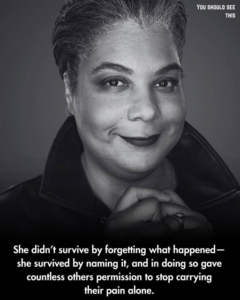
 At twelve, her boyfriend asked her to meet him in the woods.
A dozen boys were waiting.
She told no one for years—then she wrote it down and changed how we talk about survival.
Roxane Gay grew up in Omaha, Nebraska, in a loving home. Her Haitian immigrant parents adored her. When they noticed she liked making up stories, they bought her a typewriter. She was quiet, awkward, happiest with books. She was close to her two younger brothers.
She was twelve when her boyfriend told her to meet him in the woods.
“There was an incident,” Roxane would later say in her TED Talk, choosing those words carefully. “I call it an incident so I can carry the burden of what happened.”
He brought friends. A dozen of them. They took turns.
“Some boys broke me,” she said, “when I was so young, I did not know what boys can do to break a girl. They treated me like I was nothing.”
She went home changed. But she told no one—not her parents, not her brothers, not a single adult who could have helped.
Instead, she began to eat.
“I knew exactly what I was doing,” Roxane later wrote. “I thought, ‘I am going to eat and get fat and protect myself because boys don’t like fat girls.’”
She gained weight on purpose, building what she would later call her “fortress”—flesh as armor, distance as safety. Her parents watched their daughter transform and didn’t understand why.
When she returned home from Phillips Exeter Academy for breaks, her parents restricted her food. She lost weight. The moment someone commented on her body, she gained it back.
At Yale, where she enrolled pre-med, the structure collapsed. At nineteen, she ran away with a man she met online, twenty-five years old. It felt like relief to stop pretending to be the girl everyone expected.
It took her parents a year to find her.
She returned to Nebraska, dropped out of Yale, and rebuilt slowly. She earned a master’s degree, then a PhD. She became a professor. She wrote constantly—fiction, essays, criticism, erotica under pseudonyms—anything that let her process what she couldn’t say aloud.
In 2012, nearly twenty years after the assault, she wrote about it.
She published “What We Hunger For.” It was raw and devastating. It didn’t just describe the woods—it traced the aftermath, the decades spent living inside a body turned into protection.
Women responded immediately. Hundreds. Thousands. They recognized the silence, the shame, the strategies that looked like self-destruction but were really survival.
In 2014, she published Bad Feminist.
The title was deliberate. She called herself a “bad feminist” because she loved things feminism frowned upon—certain music, pink, romance novels. She argued that perfection was a trap, that feminism had to make room for contradiction.
“I would rather be a bad feminist than no feminist at all.”
The book became a bestseller. Roxane Gay was suddenly everywhere—writing columns, teaching, editing, speaking.
And the labels followed.
When she wrote about race, she was called divisive.
About feminism—too demanding.
About weight—irresponsible.
About publishing—difficult.
She noticed the pattern.
“A woman who demands equality is labeled difficult, emotional, or crazy. That tells you who benefits from her silence.”
She had lived in silence for two decades. She knew who it served.
So she kept writing.
Her novel An Untamed State explored trauma through fiction.
Hunger traced her life into “Before” and “After”—the woods dividing everything.
Not That Bad gathered voices survivors were told to minimize.
Each book pulled language from silence.
She edited. Mentored. Created space. Challenged institutions. Built platforms for voices that were easier to ignore.
The criticism never stopped.
Radical. Angry. Too much.
She understood those words weren’t random. They were tools—meant to shrink, dismiss, erase.
But she also understood this:
If your silence benefits someone, your voice threatens someone.
Roxane Gay refused silence.
She wrote about Haiti, about belonging, about culture and power. She helped shape a generation of writers. She built communities around words.
She never claimed to be healed.
“I am as healed as I’m ever going to be,” she said.
But she proved something essential: survival doesn’t always look like recovery. Sometimes it looks like telling the truth anyway.
The girl who built a fortress out of her body became the woman who built a life out of her voice.
And every time someone calls her difficult, emotional, or too much—she knows she’s saying something they hoped she never would.
Leave a Reply
You must be logged in to post a comment.