
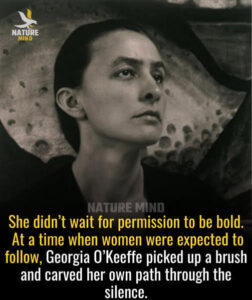
 She was born in 1887, in the quiet town of Sun Prairie, Wisconsin. No one could have imagined then that Georgia O’Keeffe would grow up to change the face of American art.
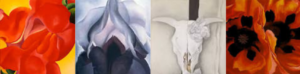
While women artists were often expected to stay in the background, O’Keeffe painted with fierce independence. After studying at the School of the Art Institute of Chicago, she began to break away from traditional styles. Her flower paintings like Black Iris III and Red Canna weren’t fragile. They were bold. They didn’t whisper. They demanded you stop and feel.
By the 1920s, Georgia had fallen in love with the vast skies and haunting beauty of New Mexico. The desert’s bones, red cliffs, and endless horizons became part of her language. Through her brush, silence became color, and solitude turned into strength.
She married photographer Alfred Stieglitz, who helped bring her work into the spotlight. But she was never just someone’s muse she was a visionary, entirely her own.
Even as her eyesight dimmed in later life, her spirit burned on. She painted from memory. She sculpted. She refused to stop. Because when the soul speaks clearly, art always finds a way.
Her paintings now hang in the most respected museums around the world. But her true legacy lives on in every artist who dares to see differently.
Georgia O’Keeffe didn’t just paint the natural world.
She became part of it.
Leave a Reply
You must be logged in to post a comment.