
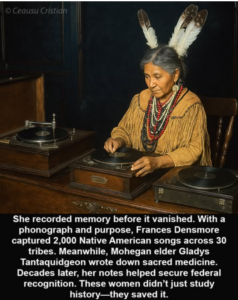
 Long before digital preservation or cultural funding, two women quietly reshaped the course of Native American history. Ethnomusicologist Frances Densmore, working in the early 20th century, recorded more than 2,000 tribal songs on wax cylinders using rudimentary phonograph technology. Her work documented ceremonial chants, healing songs, and oral histories from dozens of tribes—many of which were at risk of being lost to colonization and cultural suppression.
Across decades, another guardian emerged: Gladys Tantaquidgeon, a Mohegan elder and traditional medicine woman. She chronicled her tribe’s ancient remedies and beliefs in handwritten notebooks. Though stored away for years, these records proved crucial when the Mohegan Tribe sought federal recognition in 1994—a process requiring deep proof of continuous cultural identity. Her documentation helped restore sovereignty and inspired a cultural renaissance marked by the founding of the Mohegan Sun.
These acts of preservation were more than academic—they were acts of resistance. In a world that sought to erase Indigenous cultures, these women safeguarded what mattered most: language, ceremony, and memory.
Their legacy remains a cornerstone of historical preservation and Indigenous resilience.
Leave a Reply
You must be logged in to post a comment.