
A Homily Inspired by the Guadalupe River Flood
By Joseph Barisonzi
When the Earth Breathes
It starts quietly. A trickle against the bank. A tension in the soil. The scent of silt rising.
Sometimes it begins with rain—three inches, then five, then a sky too full to hold back. Not weeping, but nourishing: feeding aquifers, forests, and soil. Not disaster, but delivery. Until we render it something else.
Other times it begins long before the rain. With decisions. With denial. With a dam that should have been repaired decades ago. With budgets slashed, oversight weakened, and environmental priorities treated as political inconveniences, with a breath long held.
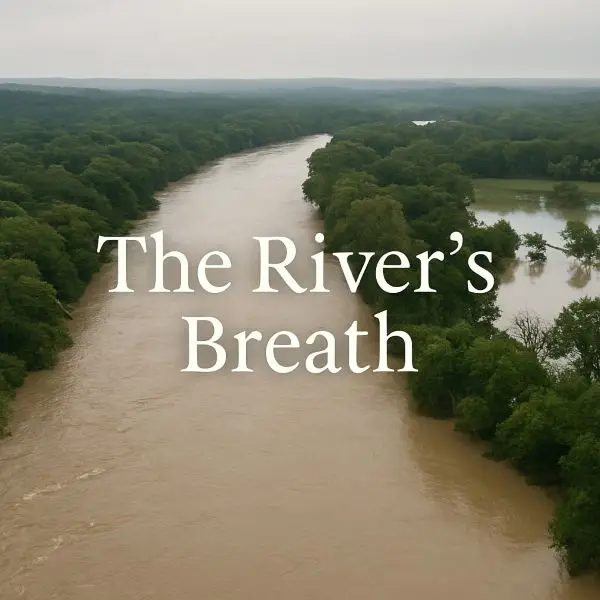
On July 4th, 2025, the Guadalupe River in Texas rose faster than anyone expected. The channel swelled and then overflowed, pushing water across roads, through fields, into bedrooms. The power went out. Cell towers failed. People waited for help that couldn’t reach them. And in the chaos, two teenage counselors—Marisol and Jacinta—stood waist-deep in the current, holding onto the children they had promised to protect.
Both were on J-1 visas, international summer workers from Mexico. Their very presence—offering care, rooted in love, standing in the river—was the kind of presence some politicians now wish to eliminate. But in that moment, there was no border. There was only breath.
When the water rose too high to move safely, they paused. One of them pulled a pen from her pack. Quietly, methodically, they wrote the names of each girl in their care on her arm. Letter by letter, one by one. Not because they had given up, but because they refused to let anyone be forgotten.
In the days that followed, it was the Mexican consulate that publicly acknowledged the courage of Marisol and Jacinta, offering recognition and support. Their government’s response stood in stark contrast to the silence from those who governed the land they served. And though we so often call floods disasters, in that moment, the river was not merely a threat. It was not a revelation. It was reality—undeniable, unavoidable.
The water showed us what we are too often unwilling to see: the fierce and tender courage of love in the face of collapse. With a pen pulled from a plastic zip pocket, they wrote each girl’s name on their arms—letter by letter. Not out of fear, but devotion. What they wrote was not surrender. It was a sacrament. A sacred act of witness carved in waterproof ink.
More than a year earlier, on June 24th, 2024, the Rapidan Dam in Minnesota had done something quieter, but no less inevitable. Its western abutment, long eroded, had been weakening for years. The structure held back decades of sediment, debris, and buried memory. And when the water finally breached the weakened side, it did not explode—it sighed. The bank slumped. The hillside moved. And with it came the contents of a forgotten holding: tree limbs, fence posts, waterlogged toys, shattered lumber. The river exhaled. Like silt borne on the current, not all that the river carries is debris. Some sediment is blessing—memory, mineral, story—settling where new roots might take hold
That same week, historic floods hit parts of South Carolina, wiping out access to potable water for entire towns. Not isolated events. Not acts of God. A chorus of systems returning to form—each one an exhale of the living Earth.
Three weeks after the Rapidan failure, I walked a section of the riverbank downstream with the Green Crew—young conservationists who had spent the spring planting sedges, clearing trails, and learning the language of resilience. The Rapidan breach was still fresh. Too fresh. It was not distant history. It moved beneath the surface. And as we walked the trails—still present but layered with silt, fractured and veiled—we felt the echo.
The trails were still there, but barely. Covered. Fractured. A shadow of what they had been. The saplings we planted were hidden or broken. Soil rearranged. But something else remained. The roots had held. The work, changed though it was, had not been erased. And neither had we. What had shifted was not just the path of the river but our understanding of its breath.
Nature does not deny the flood—it incorporates it. Beavers do not build against the current; they build with it. Wetlands do not resist excess; they welcome it, spread it, soften it. These are not just poetic images. They are structural truths. Ecological systems offer blueprints for human ones—if we are willing to learn not just from nature’s beauty, but from its biomechanics.
Flooding is not failure. It is how the river breathes. And those of us who walk with rivers—who learn their rhythms from flow charts and floodplain maps, and from soil-stained boots and whispered stories—know another truth:
Flooding is not the river recalling who it once was—it is the river breathing as it always has, carrying what we tried to bury and releasing what we refused to name. It is the river being who it has always been—despite all our efforts to make it something else. It is we who must remember. Only by remembering can we begin to move in rhythm with what breathes beyond us.
Theologically, we might name this breath ruach, the Hebrew word for wind, breath, spirit. In Lakota, it is niya—life-force moving through all beings. Science names it the hydrologic cycle—reshaping every system it touches, from climate to community.
When the river inhales, it gathers strength. When it exhales, it reshapes the world. This is not metaphor—it is motion. The metabolism of the Earth. And we are part of it.
Every inhale implies an exhale. What is gathered must be released. What swells in one place must subside in another. One watershed’s exhale is another’s inhale. The aquifer’s gain is the stream’s loss. The floodplain’s overflow becomes the prairie’s nourishment.
Breath is not solo—it is shared. A rhythm of reciprocity, alive and ancient. When the river breathes, we are not witnessing revelation—we are witnessing reality. Life in its truest form. Not all floods are holy. But all are truthful. And sometimes, truth is the holiest thing we can face. To hear the river, we must listen not just to its stories—but to its systems.
Pulmonary Hydrology
The breath of a river is not just a metaphor. It is a function. It is a form. It is science. It is spirit. Ecologists call it pulsed connectivity—the essential, rhythmic exchange between a river and its floodplain. As researchers, Tockner et al. note, ‘Floodplains are pulsing systems, redistributing energy, nutrients, and organisms across the landscape. Disrupting these flood pulses, the researchers warn, leads to *‘hydrological drought, biodiversity loss, and ecological fragmentation’—the ecological equivalent of suffocation. In a healthy watershed, the river rises seasonally, gently overflowing its banks, and spreads itself into the lowlands. This is not an overflow. This is intentional. It is how nutrients are distributed, how forests are seeded, how wetlands are refreshed, how aquifers are replenished. In this breath, the land is fed. As Tockner and colleagues emphasize, ‘Periodic inundation maintains soil fertility, replenishes groundwater, and sustains wetland habitat.’ Flooding is not drowning—it is feeding.
Floodplains are not boundaries. They are lungs—exchanging oxygen for carbon, nitrogen for sediment, memory for renewal. When rivers spill across them, they don’t just deliver water—they deliver life.
But we do not trust this breath. Every time we dam a tributary, every time we build over a wetland, every time we pour runoff from fertilized fields into the channel, we are not just altering a system—we are suppressing a breath. And like any organism denied its breath, the river will eventually convulse.
Climate change has only amplified this violence. Warmer air holds more moisture. Storms release more rain, more quickly. The timing of snowmelt is shifting. What was once a slow spring exhale has become a sudden heave. The sponge is gone. The slide remains.
When the floodplain can no longer absorb the excess, the excess finds a way. Through homes. Through highways. Through habit. Through illusion. This is not divine punishment. It is an ecological consequence. And perhaps, if we are willing, it is also an invitation.
In Minnesota, 92% of the original floodplain wetlands are gone. Replaced with soybeans. Asphalt. Storage facilities. We’ve treated the land like a warehouse floor—efficient, dry, productive. But dry only because we’ve tiled it. Drained it. Tiled it again. We’ve turned the sponge into pavement.
As ecologist Jack Stanford writes, “Floodplain connectivity is the heartbeat of a living river.” We’ve made breathing impossible. And breath does not belong on a spreadsheet. It belongs in a body.
What we see as a seasonal nuisance—the flooded road, the wetland overflow—is in fact the circulatory system of the land doing what it has always done. And what we’ve called infrastructure is too often an exoskeleton of denial. Every rerouted stream and tile line is an attempt to hold the Earth’s breath. To make life more profitable—and less alive.
As biologist and ecofeminist Sandra Steingraber writes, “The Earth is not a mechanism but a being. And beings do not act like machines.” Biomimicry teaches us that thriving systems don’t fight the breath—they move with it. Restoration begins when we pattern ourselves after the pulse of the land.
We have not forgotten because of science. We have forgotten because of disconnection — because we treat floodplains as wasted space instead of sacred lungs, and inherit stories that call rivers dangerous and wetlands disposable.
But older stories remember. Dakota traditions speak of the Minnesota River not as a border, but as a relative—a place of instruction, migration, renewal. In these teachings, water is not property but kin. To divert a river is to disrupt a relationship. To tile a wetland is to silence a teacher.
As Rev. Rebecca Parker reminds us: “The Earth does not belong to us. We belong to the Earth. We are its members, its body, its breath.” We cannot treat land like a ledger and act surprised when it stops loving us back.
The breath is still trying to move—but it is shallow. Strained. In some places, the land drowns in too much water. In others, it gasps for lack of it. Flood and drought are not opposites. They are symptoms of the same severed cycle. We cannot engineer our way out of a crisis born of forgetting that we are part of the system we seek to control.
If breath is to return, we must let it move through us again.
Remembering the River
Carter was the one who found it. He bent over near the willow bend, boots half-sunk in silt, and lifted it gently from the mud. A folded church bulletin. Waterlogged but legible. The ink was smudged but not lost. The date was from two summers ago. The name of the church—still visible in the corner—was from a small town upstream, one we knew had been hit hard.
We stood silently. This was not trash. This was testimony. I felt the ache of recognition—that the river had carried not just debris, but memory, and placed it directly in our hands.
What else had the river carried? A wedding band slipped from a swollen finger. A photograph from a family fridge. Soil from ancestral gardens. Ashes were scattered at a favorite fishing spot.
To speak of the river’s breath is to speak of its memory—not stored in vaults, but in sediment. Not archived, but embodied.
And yet, when we name memory, we so often place it in the mind. But the river remembers not with cognition, but with movement. It is remembered by carving. By carrying. By depositing. It remembers by refusing to stay within the lines we’ve drawn for it.
This is not a metaphor. It is a geological truth. Sediment cores pulled from floodplains tell stories in layers—wet years and dry years, drought and abundance, fire and healing. The river remembers everything we try to forget.
But the remembering is not just backward-looking. It is rhythm. It is a return. When the river inhales, it gathers stories. When it exhales, it releases them.
Carter didn’t speak for a while. None of us did. We stood holding that bulletin like it might fall apart with our breath. Eventually, he said, “Someone held this in their hands. It meant something.”
And that was enough. This moment, too, meant something. The way the soil pulled at our feet. The way the sunlight hit the silt. The sound of frogs reclaiming the silence.
As ecologist Kristine DeLong reminds us, “Rivers are not static archives. They are dynamic storytellers—shaping what they carry, and reshaped by it.” And as theologian Rita Nakashima Brock writes, “Redemption begins when we pick up the pieces, not to restore what was, but to witness what is becoming.”
The river does not remember sentimentally. It remembers by breathing forward. And what it carries forward—be it bulletins or birch leaves—is not a longing for the past, but a pulse into the future.
We are not here to dam the breath. We are here to feel it. To hold it gently. To walk alongside it without needing to master it. The sacred is not just in the memory. It’s in the carrying forward. And it’s in the exchange—the breath passed from water to soil, from elder to youth, from memory into motion.
Sacred Exchange
Breath is never ours alone. We breathe what trees exhale. Trees breathe our carbon. The river breathes into the soil, which becomes grain, bread, and body. Nothing that lives breathes in isolation.
Flooding, like breathing, is not an accident. It is anatomy. A vital expression of watershed health. A healthy river does not merely carry water—it distributes life. And it does so through flood. The interdependence of breath is not just biology. It is a sacred design. It is a covenant.
To breathe is to participate in a choreography older than memory and deeper than doctrine. In the Hebrew Scriptures, ruach is the animating breath that moves across creation. In Lakota teaching, niya is the life-force carried by breath, passed through generations. In Zen practice, breath is the doorway to awareness. Breath is what roots us. Breath is what moves us. Breath is what joins us to the mystery.
As Rev. Laurel Hallman writes, “We are not called to dominate nature, but to participate in it.” This participation is not passive. It is a sacred exchange. Hydrologist Ellen Wohl describes this exchange in ecological terms. She notes that “healthy river systems require connectivity—not just along their channels, but across their floodplains and between their banks and groundwater. Disruption of this connectivity—this breath—compromises the resilience of the entire system.”
The science is clear: rivers that cannot exhale cannot live. And ecosystems that cannot breathe cannot heal. As river scientist Luna Leopold wrote, “The health of our waters is the principal measure of how we live on the land.” Restoring the right to flood is not a luxury—it is how we heal.
Sacred exchange is not just science. It is a relationship. It is rhythm. It is reverence.
This is why we restore, not merely to repair damage, but to reenter the relationship. This is why we plant—not to impose order, but to learn the timing of the land. This is why we listen—not to master, but to accompany.
In the field with the Green Crew, we knelt not as engineers, but as students. Planting sedges with our hands, we talked about timing and flow, but also about grief and hope. One elder volunteer, retired from his career as a stormwater engineer, quietly said to a teenager beside him, “I used to think the job was to hold the water back. Now I think it’s to make room for it.”
The young man nodded and said, “So we’re helping it breathe?” “Yes,” the elder said. “And we’re learning how to breathe, too.” This is sacred choreography. Not dominance. Not defense. But reciprocity.
Sacred exchange is what the river offers when it overflows its banks and feeds the forest. That floodwater recharges aquifers, restores fish spawning grounds, and invites the return of native plant communities long suppressed by engineered flows. It is what we offer when we move with that flow instead of against it.
And there is joy in that. There is joy in relinquishing control. Joy in kneeling beside a child and teaching them the name of a plant that was once nearly gone. Joy in realizing that restoration is not about going backward—it’s about moving forward differently.
Sacred exchange reminds us we’re not above the system—we are the system, breathing with it. We are part of the breath. We are part of the river’s rhythm. We are part of the hope.
And in that rhythm, in that breath, is grace.
The Joy of Breathing Together
Joy is not a distraction. It is what keeps the breath moving. When we inhale responsibility, we must exhale connection. When we inhale grief, we must exhale laughter. This rhythm is not indulgent—it is essential. The river does not just flood. It sparkles. It sings. It gurgles in joy around rocks. And so must we.
I remember being in Honduras, helping build composting latrines on a hillside where erosion gnawed at the path beneath our boots. It was the kind of hot where the air feels heavy before the sun even rises. We were hauling buckets of sand up the slope when one of the youth looked over at me, face covered in sweat and dust, and deadpanned, “You better be paying me in mango smoothies.”
We all cracked up. Someone made a joke about leeches. Then another. The laughter built—not to escape the work, but to carry it. We were breathing together through effort, absurdity, heat, and hope.
I’ve heard that same laughter bloom in Minnesota—on the banks of the St. Croix, among cattails and garbage bags, with high schoolers turning every retrieved object into a comedy sketch. I’ve seen it on work days in Lyndale, when teenagers debated what color to call the sunset as they balanced on shaky ladders and peeling paint.
The breath of the Earth may be sacred, but so is the breath of a joke. Of a belly laugh. Of a moment where we forget who we’re supposed to be and remember that we’re alive. Laughter is the exhale. And in justice work, the exhale is salvation. Theologian Thich Nhat Hanh once wrote, “Sometimes your joy is the source of your smile, but sometimes your smile can be the source of your joy.” That, too, is breath. That, too, is practice.
In many Indigenous traditions, laughter is not peripheral to ceremony—it is part of the ceremony. Among the Anishinaabe, humor is revered as a sacred balancing force—a way of moving grief into healing and ceremony into life.
The Green Crew knew this instinctively. They laughed in the clay and in the rain. They teased each other while planting sedges, turned rootballs into punchlines, and made music from the squelch of their boots. Their laughter didn’t ignore the flood—it embraced it. It was an act of sacred resilience.
And in those moments, something shifted. We weren’t just planting. We were breathing together. Spiritual writer Joanna Macy calls this “active hope.” Not hope as optimism, but hope as engagement. As showing up. As exhaling even when the air feels thin.
So here is the invitation, not just to restore but to rejoice. To walk the riverbank and listen not only for warning, but for wonder. To laugh with the river, not because it is safe, but because it is still alive—and so are we.
This is not a sentimental joy. It is a compost joy. A muddy joy. A joy rooted in shared breath and sacred labor. The joy of breathing together is not what distracts us from collapse.
It is what makes healing possible.
Humility and Invitation
The river does not lie. It does not flatter. It does not spin. It does not negotiate with polling data or delay for consensus. When it breaks its banks, it is not performing. It is revealing.
We live in a culture that treats consequences like a surprise. As if floods are accidents. As if erosion is sudden. As if ecological collapse is unforeseeable. But the river knows better. The river remembers every field we tilled, every wetland we drained, every story we paved over.
And still, it breathes. But that breath is growing shallow. Our infrastructure—literal and moral—was not built for this reality. Our systems were designed to control, extract, and forget. To hold breath in until the rupture. And now it has ruptured.
This is not a parable. It is a reckoning. Humility is not weakness. It is the wisdom to know we are not in control—and never were. The river does not ask our permission to rise. The floodplain does not wait for a permit. The breath of the Earth is not an entitlement. It is a gift. And we have held it hostage.
But the Earth is not asking us to be heroes. It is asking us to be kin. Not to fix it—but to return to it. Not to command—but to accompany. We have seen what happens when we try to manage breath like a budget line. When we treat soil like substrate. When we treat water like waste. When we treat the sacred like scenery. And we have seen what happens when we stop. When we kneel. When we plant. When we listen. When we laugh.
As Joanna Macy writes, “The heart that breaks open can contain the whole world.” This is the kind of surrender we need. Not to despair—but to the possibility that our place is not at the center, but alongside.
So I ask—not in judgment, but invitation: What part of your life has forgotten how to breathe? Where have you built levees where floodplains belong? The flood is not coming. It is here. So is the breath. So is the invitation. The river’s breath is life asking us to move differently through the world.
May we rise to meet it—with humility, with courage, and with kinship. Not because we know where it leads. But because choosing to breathe together—despite uncertainty—is itself an act of sacred defiance.
May we walk gently upon the Earth, in peace and with purpose.
This homily is part of Walking Gently: Homilies for a Living Earth, a year-long reflection by Joseph Barisonzi offered to the woods, waters, and wild kin of the Minnesota Valley. Read more here. To connect directly with Joseph and explore his work, and his service (and join him on a walk along the Minnesota River, email him directly at: jbarisonzi@gmail.com
Printed with Permission
Leave a Reply
You must be logged in to post a comment.